What is ETHR?
We’ll share the updates to the second version of ETHR and details on the current pilot trial.
In this lesson:
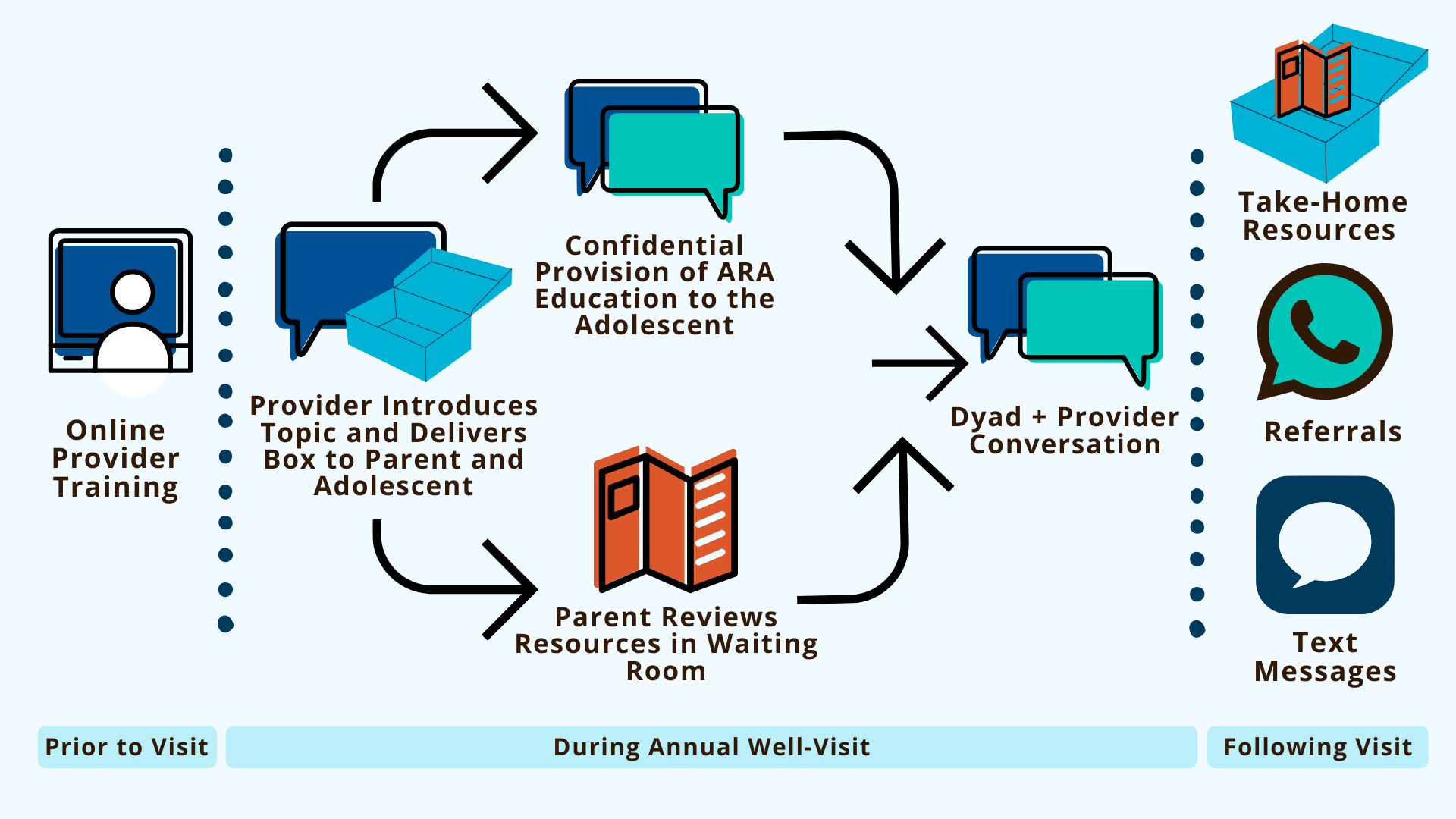
To view a flow chart of the current ETHR intervention.
To view video transcript.
Keep scrolling:
-
So now that we've talked a little bit about the importance of adolescent relationship abuse prevention, the role of the pediatrician and the caregiver, and how ETHR was developed, stand tested. I wanna share a little bit more about the current version of engaging together for healthy relationships.
So based on all the feedback from the pilot trial that I just talked about, we've revamped the intervention. It's now ETHR 2.0 and I'm really excited to share what the process looks like. Before I dive into the pieces of the intervention, I just wanna share that, we are running another pilot trial and I'm so grateful to all of you for being participants of the pilot trial.
It's very similar to what we did before. However, in this version there is no control group. So all of the participants and all of the clinicians will receive the engagement together for healthier relationships program. And we'll be able to do a lot more testing to see how people like it and get more feedback on it.
So similar to the pilot trial that we did before, we'll recruit participants who are patients of yours that will be attending a well-child visit. They will, be consented and agree to participate in the study, and then they'll be filling out a baseline survey. Have the well visit with you when you will deliver the intervention.
And then fill out surveys after the visit, one month after the visit, and three months after the visit. And they'll also have the opportunity to be part of an interview. So this is the overview of what the program looks like. And I'm gonna be going into more detail into all these different components.
But, prior to the visit, what you're doing now is a training for providers, for clinicians on a RA prevention. So that includes these videos. It includes a podcast there is a website. There's also interactive activities, and there is a 7 taps, which is a micro learning platform, a seven taps module that has the.
Basics of ETHR and you can tap through it at any time to refresh yourself on the program, particularly before you are providing this program to patients during the visit for any patient that's enrolled in the trial. You'll introduce the topic and then provide a box, which I'll talk about in a second, that has a bunch of resources for families.
You'll provide the part of the intervention for adolescents during your regular confidential social history that you would normally do. And during that time the parent can review the parent resource guide in the waiting room, and then there's a brief, caregiver, adolescent provider conversation that happens at the end.
And I'm gonna go through these pieces in more detail. It's very brief and it all fits into the natural clinical workflow that you already have. The family will get a box that has a lot of resources in it which I'll talk about in a subsequent video. If a family discloses that they need resources that they're experiencing, partner violence, we have a warm referral service available, so you can connect directly with a local victim services agency.
And families will also receive text messages after the visit, which I'll also talk about in a subsequent video. So that's the overall blueprint. So the different pieces of ETHR. So for clinicians, we have the main guides which are the different components of the program that you will be implementing.
And so I'm gonna go through these guides in a lot more detail, but the guides are essentially, I. Phrases and words that you can use to deliver this program. And it all fits into the natural kind of clinical workflow. We also have some guides if there are disclosures. So one of the things that can be really challenging is if there's a disclosure that if either an adolescent describes that they're experiencing partner violence or the a parent does, then it can be helpful to know what to say. And so we have those guides available. Now, as a reminder, we're never asking anybody if they've experienced partner violence, but disclosures can happen, especially because you're setting up this healing centered environment for families. We have warm referrals, and then we also have a website that you can refer to at any point in time as well as all the training materials that I talked about before.
And then in clinic, like I said we will be providing this con the confidential education for the adolescent as well as the family education. I wanna also note that if a parent or adolescent does not want. The caregiver to leave the room during the confidential history. We do have scripts for that as well, which I'll talk about in subsequent videos.
Like I said, there's the resource box. So in the resource box are guides for the caregiver, the adolescent, and the dyad. There's a card game that parents and adolescents can play together. There's a business card that's got resources and a little magnet that also has resources, and then also just some fun things for the family.
And the box itself has QR codes that lead to the website as well as helpline resources. And like I said, there's never a part of this program where you'll be asking families directly about partner violence. You certainly can if you want to, but that's not built into the program. And then after the visit families will have access to the website, the card game, and then follow up text messages which I'll go through the exact text messages in a subsequent video.
The text messages have resource connection, conversation starters, and then some links to social media as well as some story-based content.