
ETHR Materials
We’ll share the updates to the second version of ETHR and details on the current pilot trial, focused specifically on the guides you will use during the clinical visit.
In this lesson:
To view video transcript.
To view the full ETHR scripts.
To view FAQs.
Keep scrolling:
-
Great. Now that we've provided an overview of ETHR, I wanna dive into the clinician guides. And so these are scripts that we've created that can be used during the well child visit to implement the in-clinic part of the intervention. So these guides have been created by adolescents and caregivers for providers around how to discuss a RA during well child visits.
Now they have been created specifically for well child visits and they fit the clinical workflow of a well child visit, including the confidential social history, but they can be used in other settings as well. There's three main guides that we'll discuss now, and then some additional guides for specific situations, which I'll introduce in this video, but we'll review later.
So what these guides are is they include content to share with the adolescent and caregiver as well as some guiding questions. And in order to make things a little easier, we provided the most important verbiage in orange, which I'll show you in a second. So there's three guides. The first is an introduction, so introducing the topic to the adolescent and caregiver.
And this is meant to be done right when the caregiver is leaving, the room for the confidential social history. And as you're explaining why you need to do the confidential social history, that's when this, script would be used. Then there is a script for adolescents that you'll share with them during the confidential social history that talks about dating and dating, violence prevention.
And this can easily flow into any part of the confidential social history. The heads exam, the shades exam. Whenever you see fit, and I'll give you a couple of examples of potentially natural fits in a minute, and then there's a dyad script and this is what you'll share at the end of your visit with the caregiver and adolescent that wraps up the whole program and gives people some ideas for what they can talk about at home.
So here's the content for the three different guides. So like I said, there's the introduction and with the introduction guide again, that will happen right as you're asking the caregiver to leave the room for the confidential social history. The introductory guide introduces the topic, explains why we talk about it, gives the resource box to the teen, as well as the parent resource guide.
To the parent and the resource guides and box will be discussed further in the next training video. It also describes why the confidential conversation is important and then ask the caregiver to step out. Now what I will say is that
while most of these visits will be done in the context of a adolescent social history, the way that these guides work is that you can actually,
incorporate the adolescent guide into, a visit where the parent doesn't leave. And I'll explain that a little bit more in a moment. So the education guide, that is for the adolescent and that is what you'll discuss with them. During the confidential social history, like I said, it can also be used, if the caregiver doesn't step out of the room, [00:03:00] that discusses inclusivity, green flags and red flags.
It describes how, what to do if you are using violence or abuse and perpetration, how to seek help. And it gives us some check-in questions. And then the wrap up, that is the script that you will use at. The end of the visit, and this is for the caregiver and adolescent together again, which allows time for questions, reviewing all the resources, encouraging talking at home, and affirming the caregiver.
And then providing follow up. This would also be the opportunity to provide a warm referral, which I'll talk about in subsequent visits if if the family needs to be connected to a victim services agency. So these are what the guides look like. And I'll be talking about this more a little bit later too, but these are guides.
They're not scripts, so they provide examples of what you can say. The orange part of each guide is the most important. This particular guide is the, adolescent, the first one is from the adolescents. The second one is from the dyad. And. It provides examples of what you can say. We recommend that you don't use it like a script and read it verbatim, but really just use the content of it during your visit.
And like I said, these are guides. They're not scripts or something to say verbatim. It's really okay to tailor them to specific families. Like I also said, the adolescents may be more open and interested without their parents present, but the education script, the one for the adolescent, can be used with the parent in or out of the room.
Now, the adolescent script does have some guiding questions for the adolescents. It doesn't ask them about adolescent relationship abuse, so it doesn't say, are you in an unhealthy relationship? But it asks them some questions about what they think a healthy relationship looks like. Have they ever seen, an unhealthy relationship amongst friends and so forth.
So if you are having the parent not leave the room for whatever the reason is, maybe it may work better to to not have those guiding questions to just provide the content rather than having those guiding questions. But like I
said, because we're not asking adolescents directly if they're experiencing intimate partner violence or experiencing a RA, it's really okay to use that education script with the caregiver in the room as well.
That's what's really nice about this universal education approach, and I would recommend reviewing the guides prior to going into the visit. Like I said, they're not a script, but it's helpful to have the flow and the content reviewed before you go into the visit. Now the three main guides are what you would use during each visit, each well child visit.
But we do have additional guides because we know sometimes situations arise. Like I said. This is not, we're not screening, but because you're setting up this healing centered space, it's very possible that a young person or their caregiver may disclose. So we also have a guide available if the adolescent discloses partner violence, if the caregiver, if the parent discloses partner violence, if an adolescent discloses violent, using violence, that they themselves are using violence in a relationship, a guide, if mandated reporting is necessary.
I will be talking a lot about that in a. Future training video and a guide if an adolescent states that they have been or are currently exposed to parent or caregiver, intimate partner violence. And what these guides do is they give you some scripting, some language of what you can say if an adolescent or caregiver discloses these things.
And we've found that it can just be really helpful to have some ideas of what to say because we know that it can be really challenging to hear these things from our patients and their families and to. Have an idea in your mind of, okay, this is what I'm gonna say and this is how I can provide helpful support to families.
It can be very helpful. So we do recommend reviewing those guides but they would be situations specific only. And so now we're, finished talking about the guides and I'm gonna now dive into the resource box, which is the, resource that you're going to be giving to families during the visit.
Thank you.
Intervention scripts
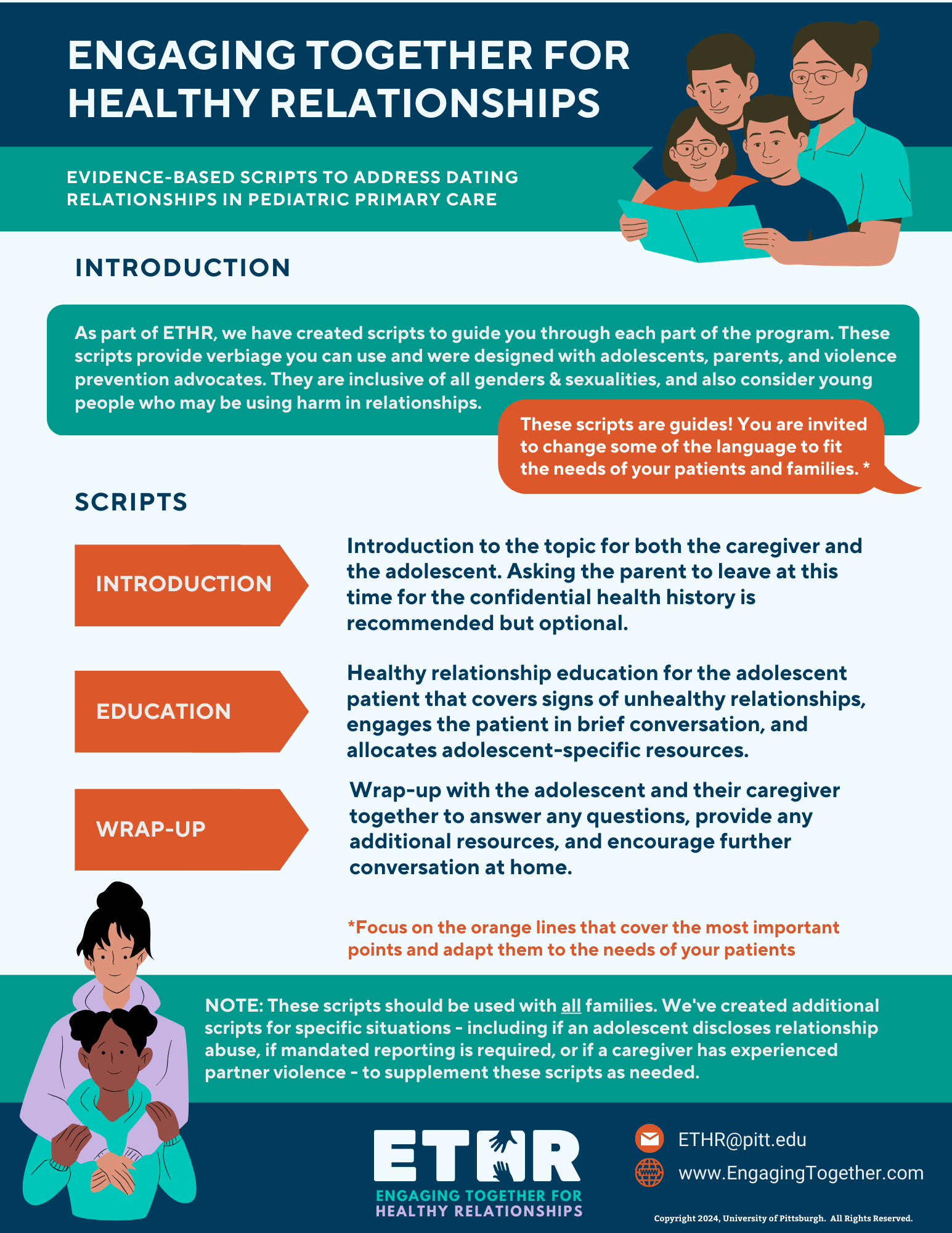
Review the scripts for the ETHR intervention. As a reminder, these scripts are meant to be guides. You are welcome to change the language in whatever way works best for you and your patients. The key points are in orange. In these scripts, you’ll find suggestions for:
Introducing ETHR
Providing education materials to teen and caregiver
Wrapping up the visit

FAQs
“What if they don't want to talk about dating?”
That's okay! Let them know you can wait until next year and offer to send them home with resources to review on their own.
“What if the caregiver wants to stay?”
That's okay! You can still deliver the education script, but know that the adolescent may be less inclined to engage. Make sure they know how to get in touch if they have any questions later.
“What if the teen discloses an unhealthy relationship?”
That might happen! We have scripts to help guide your response to teen AND caregiver diclosure.